




















Since the COVID-19 pandemic, chronic absenteeism has increased dramatically in schools, affecting both academic progress and classroom connection. National data shows that absentee rates remain far higher than before the pandemic, and local statistics reflect similar patterns across grade levels. As educators warn that consistent attendance is essential for meaningful learning, the rise in student absences highlights an ongoing challenge schools are still struggling to overcome.
Absentees Timeline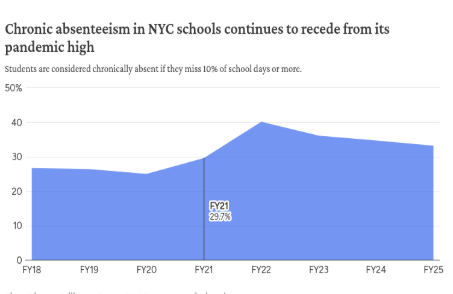
According to a 2025 chalkbeat “Chronic absenteeism exploded to 40%, the highest level in decades, during the COVID pandemic when students returned full-time to their classrooms during the 2021-22 school year… a slight dip from the 2023-24 school year, when 34.8% of students were chronically absent.”
Hstat V. Absentees
In-state, our statistics regarding student absentees look different for each cohort. 90% of Cohort 2026 (Seniors) have good attendance, while Cohort 2027 (Juniors) have 91% of good attendance, 2028 (Sophomores) hovering around 92%, and 2029 (Freshmen) 93%.
Students’ absences take away the “ideal school experience,” according to Ms. Mednick, Assistant Principal of Guidance.
“The ideal experience is when everybody is there together and you can build on yesterday’s lesson and continue and reference things you’ve discussed in the past and be able to rely on each other for what you’re learning,” Mednick said. “Whether it’s working on a project collaboratively over an extended amount of time or just being able to compare what you’re learning now to what you learned before and have different conversations.”
Teachers say showing up to school matters for more than just grades. It helps students feel confident, responsible, and connected to others. While schools push to improve attendance, students and families have an important role in making daily attendance a priority again.